Bari Weinberger Honored At Leading Women Entrepreneurs Event

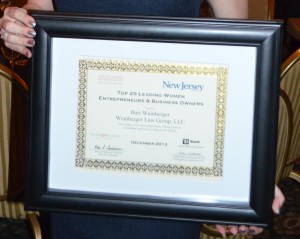
We’re pleased to announce that family law attorney Bari Weinberger, Weinberger Divorce & Family Law Group, LLC’s founder and managing partner, has been named one of NJ’s Top 25 Leading Women Entrepreneurs & Business Owners for 2013! Read more

Monmouth County Courthouse Increases Spanish Language Services

Visitors to the Monmouth County Courthouse in Freehold may notice changes that have been made recently to signage and informational services throughout the building. In an effort to accommodate Spanish-speaking litigants, the courthouse has implemented a number of measures to help non-English speakers and those more comfortable in the Spanish language to access services and find their way to their assigned courtroom. Read more

Bari Weinberger To Lead Divorce Law Education Seminar

Family law attorney Bari Z. Weinberger, founder and managing  partner of Weinberger Divorce & Family Law Group, LLC, will be a featured instructor at the upcoming legal seminar, Divorce Law Guide from A to Z, sponsored by the National Business Institute’s Continuing Legal Education for Professionals program. Read more

Bari Weinberger Recognized Among Top 25 Leading Women Entrepreneurs

Congratulations to Bari Weinberger for being named a NJ Top 25 Leading Woman Entrepreneur & Business Owner for 2013! Each year, the Leading Women Entrepreneurs Initiative recognizes a select handful of female business owners in New Jersey who exhibit outstanding performance in four areas: market potential, innovation, community involvement and advocacy for women.  Read more

5 Questions to Ask Yourself Before Filing for Divorce

For most couples, making the decision to get a divorce isn’t an easy one. So how do you know it’s really time to call it quits? Here are five questions to ask yourself before declaring your marriage done. Read more

New Book Addresses Divorce, Family Law Issues for Members of the U.S. Military

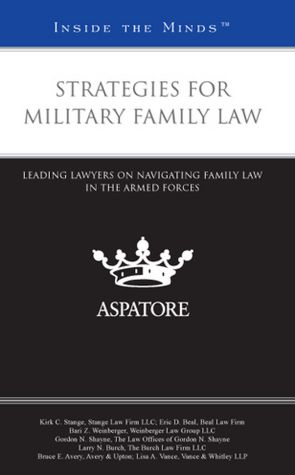
Divorces among members of the U.S. military are on the rise, making the new book, Strategies for Military Family Law, extremely relevant to members of the matrimonial and family law community. We are pleased to announce that WLG’s managing parter Bari Weinberger serves as one of the guide’s contributing authors, penning the chapter, “Getting the Best Results for a Military Family Law Client: Understanding the Nuances in this Practice Area.” Fellow WLG Attorney, Patricia Cistaro, also contributed to the chapter. Read more

Weinberger Divorce & Family Law Group, LLC Opens New Offices in Freehold

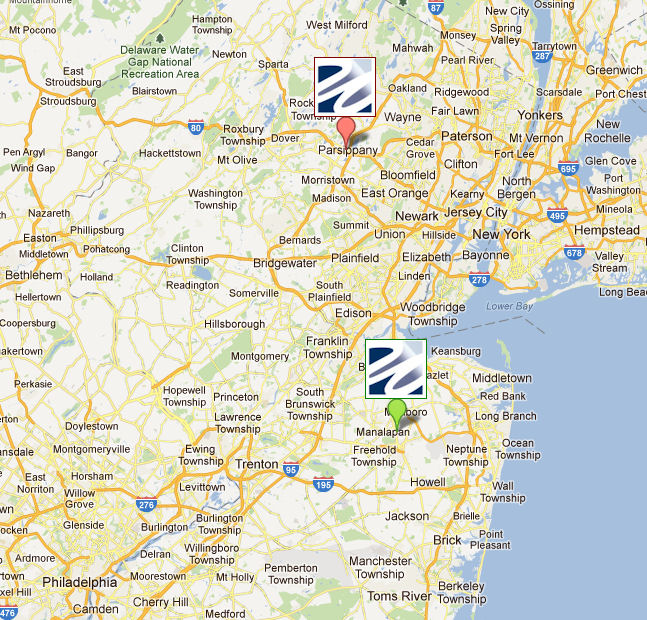
To better serve clients in Monmouth Country and the rest of southern and central New Jersey, Weinberger Divorce & Family Law Group, LLC is pleased to announce the opening of a second office in Freehold. Our law group’s headquarters will remain in Parsippany, serving northern New Jersey. WLG is happy to place our attorneys and law offices in closer and more convenient locations for our clients. As always, we understand that being able to meet with your divorce attorney easily and face-to-face is a important priority.

WLG is also excited to have attorney Robyn N. Howlett heading up the new office. Robyn comes to WLG with considerable experience and expertise in all matters related to divorce, child custody, child support, alimony and the division of assets, dissolution of domestic partnerships, civil unions, and domestic violence matters. Clients can expect the same high level of representation for their family law and divorce legal services, no matter which location they visit.

The new office opened its doors for business on Monday, May 7, 2012 and is located at 4400 Highway 9 (Route 9) South, Suite 1000, Freehold, NJ 07728. For more information or to set up an initial consultation at our Freehold office, call Weinberger Divorce & Family Law Group, LLC at (888) 888-0919 or (732) 252-0000.

The Role of Prenups in a New Jersey Divorce

Many people have heard stories about prenuptial agreements not always holding up in court. The reality is that courts will try to uphold private contracts in a New Jersey divorce, provided they were entered into with full knowledge and no coercion.

Historically, judges were suspicious of prenups because they were often used by the more powerful spouse to force the other spouse to agree to unfair terms. But today, prenups are used more routinely and looked at more favorably – when properly entered into.

To be enforced, a prenuptial agreement must be in writing, signed by both parties, and include a full disclosure of all assets and liabilities of both parties. In addition, each party is required to retain their own lawyer to separately represent their individual interests.

During a divorce, the burden is on the spouse challenging the validity of the prenup to show there was coercion in the creation of the agreement. Whether or not there was coercion, a party can challenge portions of the prenup as unconscionable.

Generally, the prenup is looked at as a regular private contract entered into voluntarily by two adults. There are areas that cannot be agreed to via a prenup. For example, parents cannot make agreements about custody of the children or parenting time via a prenuptial agreement.

Prenups are most commonly used to protect assets acquired before the marriage, and to set forth how certain properties obtained during the marriage would be distributed. They many times also address the issue of alimony.

If you are considering a prenup, or wondering if yours will hold up in a divorce, consult with attorneys experienced in handling New Jersey divorce issues. Used for the right purposes, prenups can often reduce time and costs of litigation in the event of divorce.

Contact a skilled New Jersey family law attorney for help with domestic violence

It is natural for couples to have fights and various arguments throughout their relationship.  However, when these fights escalate to include verbal abuse and physical assault, you should know that protection is available to you.  Whether your abuser is your husband, wife, boyfriend, girlfriend or partner, domestic violence and abuse is a crime – seeking the counsel of a skilled New Jersey family law attorney is often the best method for getting help with this type of situation.  For your protection, a New Jersey family law attorney can help you obtain a restraining order.

In New Jersey, a restraining order is a court-order issued by a judge that provides specific protection for your safety and well-being.  If you are the victim of threats or abusive behaviors, you should contact a local police department, call 9-1-1 or go to a local court house and report the incident.  A judge is available and is on-call, even after hours, for these types of emergency situations and has the power to execute an immediate temporary restraining order.

After a temporary restraining order has been issued, a formal hearing will take place before a superior court judge in the family division to determine if the temporary restraining order should be converted into a final restraining order.  Both sides have the opportunity to present their cases to the court, and a judge will make the final decision.  If granted, this restraining order serves as full protection for an indefinite period of time.  If the abuser fails to comply with the terms of the final restraining order, the violation can result in a criminal record and possible jail time.

For domestic violence questions or concerns, contact us in New Jersey at the Weinberger Divorce & Family Law Group, or call us at (973)520-8822.  We are a family law firm with the experience and commitment to help you with your most complex legal needs.

Basic Information about a New Jersey Restraining Order

You may have experienced a bad relationship or divorce with your former partner.  A New Jersey restraining order is a reality and solution for those who feel their safety and personal space is threatened by another person.

A New Jersey restraining order is a civil order issued by a judge.  The order provides protection against the presence of unwanted parties such as a former spouse, boyfriend, girlfriend, present or former household member, and other parties identified in the restraining order.

The precipitating events and reasons to seek a New Jersey restraining order vary, but most seek such an order because they feel threatened by another person.  Events of domestic violence often precede the need for a New Jersey restraining order.  In general, if a family member or other person attempts to harm you (with our without a weapon) or gives you reason to believe they are planning to harm you, then that person may have committed an act of domestic violence.

Domestic violence occurs in many forms.  People may seek a New Jersey restraining order as a derivative of the following actions: assault, terroristic threats, kidnapping, criminal mischief, false imprisonment, sexual assault, harassment, and stalking.

New Jersey temporary restraining orders can be granted by means of an emergency order when the courts are closed and can be facilitated by contacting local police or 911.  A final restraining order is granted once both parties are given the opportunity to tell their side of the story and the judge decides the temporary restraining order should be made permanent in order to protect the safety and well-being of the victim.

Obtaining a New Jersey restraining order can result in the following:

–          A no-contact provision that prohibits the abuser from communicating with the victim

–          An order that permits the abuser to remove limited items from a previously shared space in the company of a law officer

–          Emergency financial support from the abuser, including support for minors

–          Temporary sole possession of the home for the abused