

New Jersey Divorce Road Map
If you are considering a New Jersey divorce, you may be unsure about what to expect during your divorce process. To help you, we have created a divorce road map: a complete map of the New Jersey divorce process – from the initial filing of the Complaint for Divorce to the final trial stage – to help ease the uncertainty that comes with filing for divorce in the State of New Jersey.
Note: Since each New Jersey divorce case is different, it is important to remember that your divorce may deviate from the stages listed below. Please contact us should you have questions about your divorce procedures.
Click on each image to expand into full size PDF.
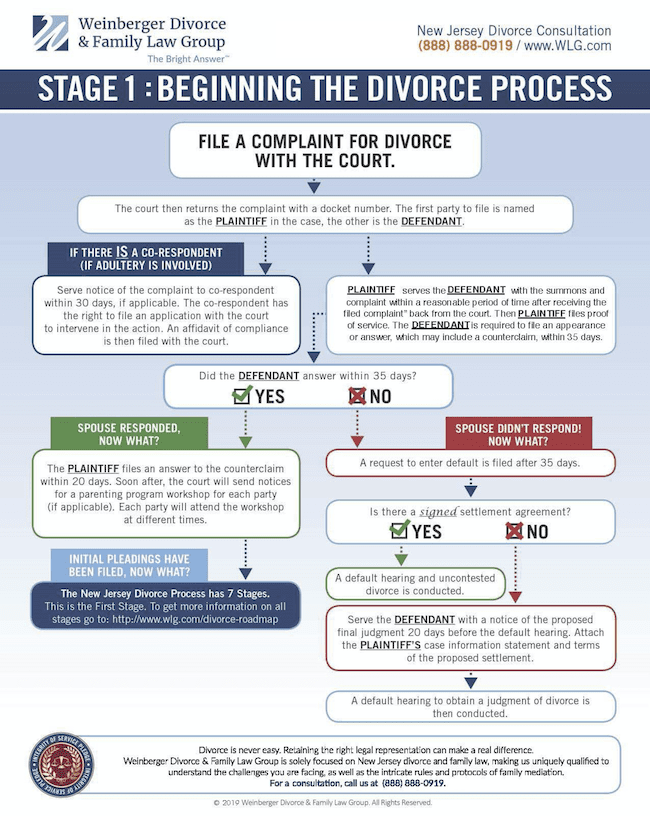
Stage 1: Beginning the Divorce Process
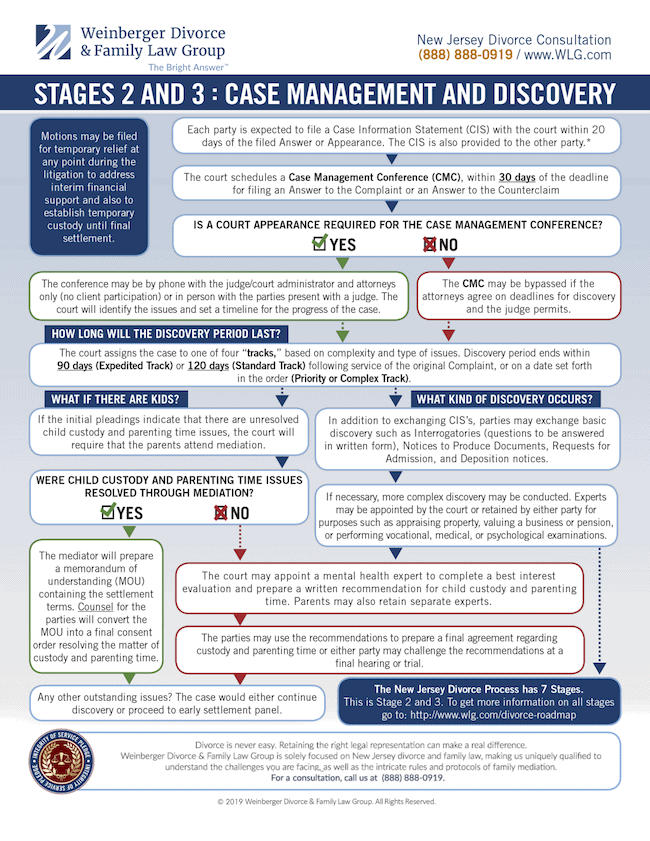
Stage 2 & 3: Case Management and Discovery
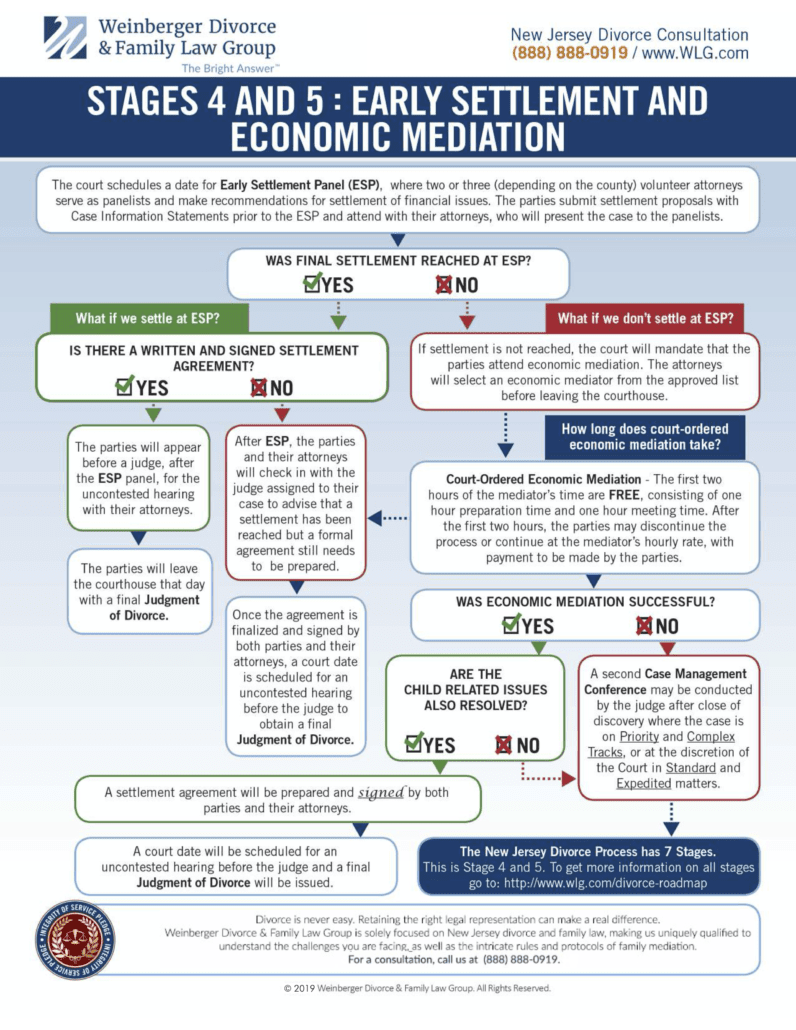
Stage 4 & 5: Early Settlement and Economic Mediation
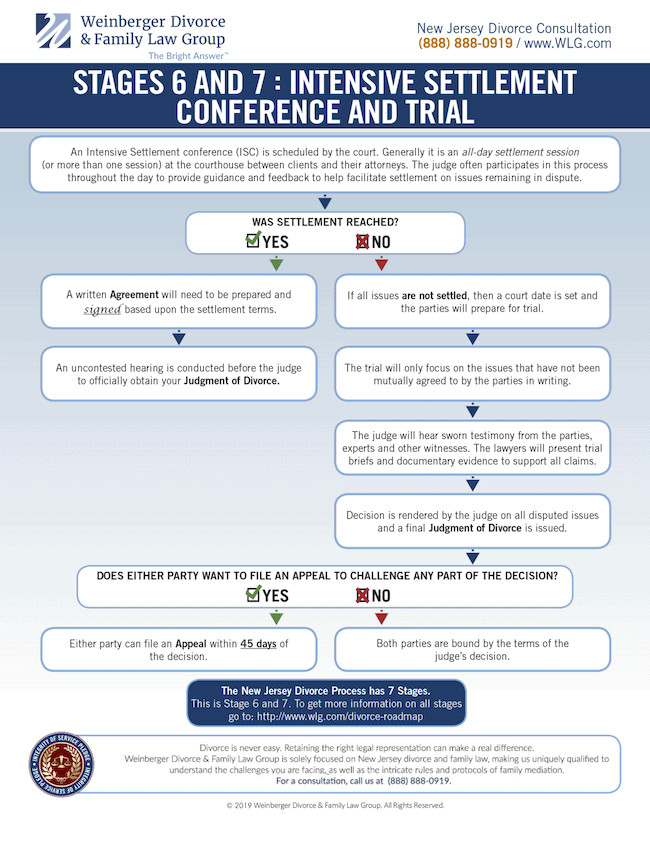
Stage 6 & 7: Intensive Settlement Conference & Trial
The New Jersey Divorce Process
Stage 1—Beginning the Divorce Process: Complaint for Divorce
The typical New Jersey divorce begins with an NJ divorce form known as the Complaint for Divorce. This form is one party’s request for the court to grant a judgment of divorce, and usually includes:
- The selected grounds for New Jersey divorce, such as:
- Irreconcilable differences
- Adultery
- Separation
- Desertion
- Extreme cruelty
- And more
- An Affidavit of Insurance Coverage form that identifies your existing insurances, such as:
- Life insurance
- Medical insurance
- Automobile insurance
- Homeowner’s insurance
- And more
- A Confidential Litigant Information Sheet that provides the court with various personal identifying characteristics about you, including:
- Date and place of birth
- Social security number
- Driver’s license number
- Gender
- And more
Stage 2—Case Management
Once the Complaint for Divorce has been filed, your New Jersey divorce matter will be assigned a docket number, and the other party will be served with the divorce papers. The court may then set a date for a case management conference to:
- Meet all of the parties involved in the NJ divorce
- Assess the issues of your New Jersey divorce
- Fix deadlines for the exchange of documents
- Determine if any experts will be required
Stage 3—Discovery
Discovery is the process by which both parties exchange necessary information. For instance, if one spouse handles the financial matters of the family, then he or she will likely be required to produce bank and credit card statements, a listing of assets, business records, and more.
In addition to exchanging physical documents, both parties may need to complete interrogatories (written questions) and a case information statement, which itemizes each party’s income, monthly budgets, assets, and liabilities.
In some situations, a party may be questioned under oath about certain topics pertaining to an NJ divorce—this is known as adeposition. While a deposition may seem informal, the testimony is recorded and a transcript can be made available for later use in the court proceedings.
Stage 4—Early Settlement Panel
During the discovery phase, your attorneys should be participating in settlement discussions to resolve the divorce case. If, however, your New Jersey divorce case is not settled by a date scheduled by the court, you will be required to appear before the early settlement panel with your NJ divorce attorney. The panel will discuss your issues and provide recommendations on how to best reach a resolution. A mutual acceptance of the panel’s recommendation will enable a judge to grant your New Jersey divorce before leaving the courthouse that very day.
Stage 5—Economic Mediation
If you do not resolve your issues at the early settlement panel, you will be required to select an economic mediator to help you resolve your NJ divorce matter. The mediator meets with both parties in order to assist you in reaching an amicable settlement.
Stage 6—Intensive Settlement Conference
If your New Jersey divorce cannot be settled in the economic mediation phase, then the court will ask both parties and their NJ divorce attorneys to return to court for an all-day settlement conference. The primary goal of an intensive settlement conference is to prevent your New Jersey divorce case from going to trial.
Stage 7—Trial
A trial is the final step in the NJ divorce process. At the trial, the judge will hear testimony from each party, experts, and witnesses before ultimately making a final decision. Barring any appeals of the decision, your New Jersey divorce will be finalized.
